Tuesday, 5 December 2017

Coordinate Geometry(Intro)

Coordinate Geometry

Today my post is going to concentrate on Introduction to Coordinate Geometry and its applications and in future posts, I’ll discuss in detail about various theorems and results in Coordinate Geometry.

Prelude

Coordinate geometry is the branch of geometry using the coordinate system, i.e., using x, y, z axes. It is also known as Analytical Geometry or Cartesian Geometry. Coordinate Geometry led to the development of Calculus (both integral and differential) that we know today. Let’s see its beginning.

Beginning
Coordinate Geometry was first developed by the French Mathematician Rene Descartes. There’s a small story associated with the development of this field. One day Descartes was lying on his bed and pondering about a problem. Suddenly, he got distracted by a fly sitting on the roof tile of his house. Being a mathematician, that scene got registered differently in his mind. This was the birth of coordinate geometry.  Descartes imagined it as follows- the roof of the house as the plane and the sides of the tile as the axes and the fly as a point on the plane.

After the development of coordinate geometry, it became more popular than the conventional Euclidean geometry used till that day. The reason is very simple. Using Coordinate Geometry, most of the theorems and results from Euclidean geometry could be proved very easily and also, using Coordinate geometry, it was much simpler to deal with non-regular shapes like ellipse, parabola, hyperbola etc. compared to Euclidean geometry. With Coordinate geometry tools, one can easily prove or explain any concept in Calculus which is the foundation of science.

Applications

Applications of coordinate geometry are almost immeasurable. It has uses in all domains of our lives. Be it economics, finance, medicine, etc. Though it has so many applications, it’s extensively used in avionics, space flight technology, Astronomy, Kinematics and Mechanics. Its use in physics (mainly in kinematics and mechanics) led to the development of closely associated fields called tensors and vectors (about which we’ll discuss in detail in another season).


It’s quite fascinating that a fly literally changed the way Mathematics was studied and it brought Science more closer to Mathematics. That is the beauty of Coordinate Geometry.

I'm Back

Hi friends,
I'm back exactly after a year!!
I wasn't available due to some personal reasons. I hope my readers don't mind that and continue to support me hereafter.
I'll start from where I left last time around i.e, The topic on Geometry.
 Cheers Guys!!!
Enjoy Reading..πŸ˜ƒπŸ˜ƒ

Friday, 13 January 2017

NOTICE

Hi friends,

This year ownwards I'm going to post a series of posts about a particular topic and the full collection will be called as a "Season".
 "Season 1" will start from tomorrow and since I had already made an introduction post on Geometry in the last week of December 2016, my first "Season" will be on Geometry.

Hope you guys will like this new pattern of posts in a season about a particular topic.

Stay Tuned..

Cheers...

Monday, 2 January 2017

NOTICE

Hi Friends,

New Year wishes to all

This is to inform you that this blog is completely for educational purpose as well as to cultivate the passion for this Universal Language of Mathematics. As a reader you are completely safe in following my blog. Feel free to post questions and topics of posts you want to see in future in the comment section.

Cheers..

Saturday, 31 December 2016

HAPPY NEW YEAR!!

                                                                          NEW YEAR NEW BEGINNING

2016 is almost over and the world is waiting to welcome 2017.  2016 was a great year for many, for some it was a year which taught many lessons and for the rest it was a year to forget. As far as this blog is concerned, 2016 was a memorable one as it marked the establishment of this blog. Whatever 2016 gave for the people, 2017 is definitely a new beginning and the world is quite optimistic about that.

We, mathematics geeks first look at the new year differently, we look  at the number 2017 first and then think about any  uniqueness in the number. It turns out, 2017 is special in its own way. Let’s look how:-

If you observe 2017 is a number of the 2P-1 where P is a prime number and 2P-1 is also a prime                                                         
                                                       2017 = 2P-1, a prime number                                                                                                                                                             
 where P=1009 which is also a prime number and this 1009 is also a special number called “Emirps”.
Emirps are primes that become a different prime when their decimal digits are reversed.

On the thirteenth of July in 2017, i.e., (7/13/17), we will get a Mersenne prime number sequence in the date. (Note, Mersenne Primes are primes of the form ${{{2}^{P}}-1}$ where P is also a prime number)

I wish all my readers a happy and prosperous new year!!

Do post in the comment section if any of the readers get some mathematical facts about the year 2017 and the number 2017.

Cheers!!                                             

Wednesday, 28 December 2016

EUCLIDEAN GEOMETRY

                                                          EUCLIDEAN GEOMETRY

Today my post is going to concentrate on a branch of Geometry called Euclidean Geometry. In this post I’m going to discuss  about Triangles and its properties.
Triangle as everyone knows is a  3-sided polygon. It has some unique properties which is of utmost importance in fields like Engineering, Architecture, Geographical Studies, Astronomical Studies and other branches of science.

Properties of Triangle

Centroid
It is the point of intersection of all medians of a triangle. The centroid divides a median in 2:1 ratio.

                                         
'G' is the centroid of the triangle ABC and triangle DEF is the
medal triangle

Incentre
It is the point of intersection of all the internal angle bisectors. The circle drawn with centre as incentre is called as incircle whose radius is given by:-
                                                                 $r=\frac{\Delta }{s}$
Where ${\Delta}$=Area of the triangle and s=semi-perimeter of the triangle
                                                           
'I' is the incentre of the triangle ABC

Circum-Centre
It is the point of intersection of all the perpendicular bisectors of all the sides of the triangle. The circle drawn with centre as circumcentre is called as circumcircle whose radius is given by Sine Rule:-

Sine Rule
In a given triangle ABC if a,b,c are the lengths of the sides opposite to the angles A,B,C respectively, then,
                        $\frac{a}{\sin A}=\frac{b}{\sin B}=\frac{c}{\sin C}=2R$
Where ‘R’ is the Circum-Radius of the Triangle.

                                     
The black line in the above figure is the "Pedal Line" and 'C' is
the Circumcentre of the triangle ABC 


Orthocentre
It is the point of intersection of all the altitudes from all three vertices of a triangle.

                                       
'H' is the Orthocentre of the triangle ABC

Ex-centre
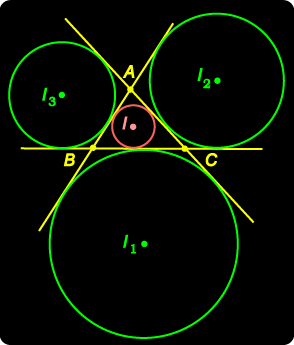
It is the point of intersection of 2 external angle bisectors and one internal angle bisector. In a triangle, there are 3 ex-centres. The circles drawn with centres as ex-centres are known as ex-circles whose radius is given by:-
                         ${{r}_{1}}=\frac{\Delta }{s-a}$
                         ${{r}_{2}}=\frac{\Delta }{s-b}$
                         ${{r}_{3}}=\frac{\Delta }{s-c}$
Where ${\Delta}$=Area of the triangle and s=semi-perimeter of the triangle and a,b,c are the lengths of the sides of the triangle.

                                         
In the given figure, the three green circles
are "Ex-circles". '${{I}_{1},{I}_{2},{I}_{3}}$' are
ex-centres of the triangle ABC

Cosine Rule
In a given triangle ABC if a,b,c are the lengths of the sides opposite to the angles A,B,C respectively, then,
                                      $\cos A=\frac{{{b}^{2}}+{{c}^{2}}-{{a}^{2}}}{2bc}$
                                     $\cos B=\frac{{{c}^{2}}+{{a}^{2}}-{{b}^{2}}}{2ac}$
                                     $\cos C=\frac{{{a}^{2}}+{{b}^{2}}-{{c}^{2}}}{2ab}$

Nine Point Circle
The nine point circle can be constructed for any triangle. It is named so because it passes through the 9 significant concyclic points defined from the triangle. These 9 points are:-
·        The mid-point of each side of the triangle
·        Foot of each altitude from each vertex of the triangle
·        The mid-points of the line segment joining each vertex to the orthocentre.
It is also called as Euler’s Circle. The centre of this circle is called as nine-point centre. The radius of this nine-point circle is given by:-
                                                         ${{r}_{n}}=\frac{R}{2}$
  Where ${{r}_{n}}$  is the radius of the nine-point circle and R is the Circum-Radius.

                                       
The circle in the given figure is the nine-point circle

Spieker Circle
The Spieker Circle is the incircle of the the triangle constructed by the feet of all 3 medians of a triangle(medial triangle). The centre of this circle is called as Spieker Centre. It has an application as it is the centre of mass of the uniform density boundary of the triangle. The radius of this Spieker  circle is given by:-
                                                          ${{r}_{s}}=\frac{r}{2}$
Where ${{r}_{s}}$  is the radius of the Spieker Circle and r is the in-radius.

                                       
'I' is the incentre of the triangle and the red colour circle is the
'Spieker Circle'

Pedal Triangle
A Pedal Triangle is formed by the points obtained by projecting a point on the three sides of the triangle. The location of the chosen point relative to the chosen triangle gives rise to some special cases:-
·        If the point is orthocentre, then the Pedal triangle is orthic triangle
·        If the point is incentre, then the Pedal triangle is intouch triangle
·        If the point is lying on the circumcircle of the main triangle, then the Pedal triangle collapses to a single line called Pedal line or Simson Line.

                 
The red colour triangle is the Pedal Triangle

Euler Line
The Euler Line is the center line of the triangle and it passes through several important points determined from the triangle, including orthocentre, circum-centre, centroid, nine-point centre etc.. However, incentre doesn’t lie on this line except in isosceles triangle where it lies on it. In the case of Equilateral triangle, the Euler Line collapses to a point.


The blue colour line in the triangle ABC
is the "Euler Line"


Many of the other properties of a triangle is based on various triangle centres like the ones discussed above. There’s an Online Encyclopedia called as “Clark Kimberling’s Encyclopedia of Triangle Centres” which lists all  the discovered Triangle Centres and their properties till date. There are almost 11,362 triangle centres listed in that Encyclopedia. The link for the Encyclopedia is given below:-
                           http://faculty.evansville.edu/ck6/encyclopedia/ETC.html


Monday, 28 November 2016

Series and Progressions

                                         Series and Progressions

Today's post is about "Series". Hope you all loved my first post on "Evolution of Mathematics".
I'm not going to talk about progressions in detail as the readers would be well-equipped with knowledge of Arithmatic, Geometric and Harmonic Progressions.
Series is infinite sequence of numbers(Complex) which either tends to a number(also called as Convergent series) or tends to infinity(also called as Divergent series). They are widely used in physics, computer science, statistics and finance.
There are various tests available to prove whether a series is converging or diverging like "nth term test" and "ratio-test".
According to "nth term test", If  $\underset{n\to \infty }{\mathop{\lim }}\,{{a}_{n}}\ne 0$ then the series diverges and according to “ratio test”, If there exists a constant C < 1 such that $|{{a}_{n+1}}/{{a}_{n}}|<C$  for all sufficiently large n, then $\sum{{{a}_{n}}}$ converges absolutely.
There are various types of series that are there in Mathematics  and still plenty of research is going on in this area.
Some  of them are:-
Ø Power Series
Ø Taylor Series
Ø Laurent Series
Ø Dirichlet Series
Ø Fourier Series
Power Series:-   A power series is a series of the form
{\displaystyle \sum _{n=0}^{\infty }a_{n}(x-c)^{n}.}  
                                          $\sum\limits_{n=0}^{\infty }{({{a}_{n}}{{(x-c)}^{n}})}$

Taylor Series:-  A function can be expressed as a series of polynomial which is calculated from the function’s derivatives at each point. It is expressed as :-

                                              $\sum\limits_{n=0}^{\infty }{\frac{{{f}^{n}}(a)}{n!}}{{(x-a)}^{n}}$
When a=0, the above series becomes “Maclaurin series”.

Laurent Series:- This is a generalization of Power Series that it accounts for both positive and negative terms. It is of the form:-
                                             $\sum\limits_{n=-\infty }^{\infty }{{{a}_{n}}{{x}^{n}}}$


  Dirichlet Series:- It is of the form
                                            $\sum\limits_{n=1}^{\infty }{\frac{{{a}_{n}}}{{{n}^{s}}}}$
Where ‘s’ is any complex number.
If all the an are equal to 1, then the Dirichlet  Series becomes Riemann Zeta Function((ΞΆ(s)))
                                        $\text{ }\!\!\zeta\!\!\text{ }\left( \text{s} \right)=\sum\limits_{n=1}^{\infty }{\frac{1}{{{n}^{s}}}}$
This function is one of the most trending functions in this century. The solution of this function is still a mystery and it is one of the unsolved  problems in Mathematics today. More on this function will be discussed in future posts.

Fourier Series:- It is a way of expressing periodic functions as an infinite series of sum of  sine and cosine functions with corresponding co-efficients.  It is of the form:-
                                      $f(x)={{A}_{0}}+\sum\limits_{n=1}^{\infty }{({{A}_{n}}\cos nx+{{B}_{n}}\sin nx)}$
More on Fourier series will be discussed in my next post.

So far the series we have discussed are infinite summation series. But there are other types of expressions also like infinite product series, infinite nested radicals, infinite continued fractions, infinite power towers etc.

Infinite Product Series:- It is of the form:-
                                          $\prod\limits_{n=1}^{\infty }{{{a}_{n}}={{a}_{1}}.{{a}_{2}}.{{a}_{3}}...}$
The infinite product is said to converge if and only if the sum
                                          $\sum\limits_{n=1}^{\infty }{\ln ({{a}_{n}})}$
Converges.

Infinite Nested Radicals:-

Ramanujan's infinite radicals
Ramanujan posed the following problem to the Journal of Indian Mathematical Society:
                            $?=\sqrt{1+2\sqrt{1+3\sqrt{1+....}}}$ {\displaystyle ?={\sqrt {1+2{\sqrt {1+3{\sqrt {1+\cdots }}}}}}.\,}
This can be solved by noting a more general formulation:
{\displaystyle ?={\sqrt {ax+(n+a)^{2}+x{\sqrt {a(x+n)+(n+a)^{2}+(x+n){\sqrt {\mathrm {\cdots } }}}}}}.\,}?$?=\sqrt{ax+{{(n+a)}^{2}}+x\sqrt{a(x+n)+{{(n+a)}^{2}}+(x+n)\sqrt{.....}}}$
Setting this to F(x) and squaring both sides gives us
{\displaystyle F(x)^{2}=ax+(n+a)^{2}+x{\sqrt {a(x+n)+(n+a)^{2}+(x+n){\sqrt {\mathrm {\cdots } }}}},\,}   $F{{(x)}^{2}}=ax+{{(n+a)}^{2}}+x\sqrt{a(x+n)+{{(n+a)}^{2}}+(x+n)\sqrt{.....}}$

which can be simplified to
$F{{(x)}^{2}}=ax+{{(n+a)}^{2}}+xF(x+n)$
{\displaystyle F(x)^{2}=ax+(n+a)^{2}+xF(x+n).\,}xxxxx$F{{(x)}^{2}}=ax+{{(n+a)}^{2}}+xF(x+n)$
It can then be shown that
{\displaystyle F(x)={x+n+a}.\,}F(x) = x + n + a
So, setting a = 0, n = 1, and x = 2, we have
{\displaystyle 3={\sqrt {1+2{\sqrt {1+3{\sqrt {1+\cdots }}}}}}.\,}
                                     $3=\sqrt{1+2\sqrt{1+3\sqrt{1+.....}}}$


  Continued Fractions will be discussed exclusively in future posts.
Hope you have enjoyed the introduction of series in this post.
I’ll be back with problems as well as in depth discussion of some of the series discussed above.
Please comment below if you have any queries.
Watch these two videos for some amazing facts about Series:-