EUCLIDEAN GEOMETRY
Today my post is going to concentrate on a branch of
Geometry called Euclidean Geometry. In this post I’m going to discuss about
Triangles and its properties.
Triangle as everyone knows is a 3-sided polygon. It has some unique
properties which is of utmost importance in fields like Engineering,
Architecture, Geographical Studies, Astronomical Studies and other branches of
science.
Properties of Triangle
Centroid
It is the point of intersection of all medians of a
triangle. The centroid divides a median in 2:1 ratio.
 |
| 'G' is the centroid of the triangle ABC and triangle DEF is the medal triangle |
Incentre
It is the point of intersection of all the internal angle
bisectors. The circle drawn with centre as incentre is called as incircle whose
radius is given by:-
$r=\frac{\Delta }{s}$
Where ${\Delta}$=Area of the triangle and s=semi-perimeter of the
triangle
 |
| 'I' is the incentre of the triangle ABC |
Circum-Centre
It is the point of intersection of all the perpendicular
bisectors of all the sides of the triangle. The circle drawn with centre as
circumcentre is called as circumcircle whose radius is given by Sine Rule:-
Sine Rule
In a given triangle ABC if a,b,c are the lengths
of the sides opposite to the angles A,B,C respectively, then,
$\frac{a}{\sin
A}=\frac{b}{\sin B}=\frac{c}{\sin C}=2R$
Where ‘R’ is the Circum-Radius of the Triangle.
 |
| The black line in the above figure is the "Pedal Line" and 'C' is the Circumcentre of the triangle ABC |
Orthocentre
It is the point of intersection of all the altitudes from
all three vertices of a triangle.
 |
| 'H' is the Orthocentre of the triangle ABC |
Ex-centre
It is the point of intersection of 2 external angle
bisectors and one internal angle bisector. In a triangle, there are 3
ex-centres. The circles drawn with centres as ex-centres are known as
ex-circles whose radius is given by:-
${{r}_{1}}=\frac{\Delta }{s-a}$
${{r}_{2}}=\frac{\Delta }{s-b}$
${{r}_{3}}=\frac{\Delta }{s-c}$
Where ${\Delta}$=Area of the triangle and s=semi-perimeter
of the triangle and a,b,c are the lengths of the sides of the triangle.
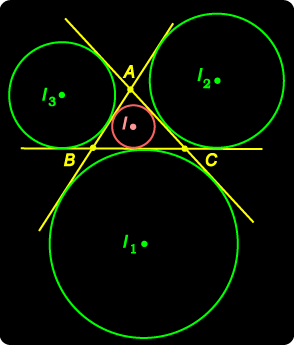 |
| In the given figure, the three green circles are "Ex-circles". '${{I}_{1},{I}_{2},{I}_{3}}$' are ex-centres of the triangle ABC |
Cosine Rule
In a given triangle ABC if a,b,c are the lengths
of the sides opposite to the angles A,B,C respectively, then,
$\cos
A=\frac{{{b}^{2}}+{{c}^{2}}-{{a}^{2}}}{2bc}$
$\cos
B=\frac{{{c}^{2}}+{{a}^{2}}-{{b}^{2}}}{2ac}$
$\cos
C=\frac{{{a}^{2}}+{{b}^{2}}-{{c}^{2}}}{2ab}$
Nine Point Circle
The nine point circle can be constructed for any triangle.
It is named so because it passes through the 9 significant concyclic points
defined from the triangle. These 9 points are:-
·
The mid-point of each side of the triangle
·
Foot of each altitude from each vertex of the
triangle
·
The mid-points of the line segment joining each
vertex to the orthocentre.
It is also called as Euler’s Circle. The centre of this
circle is called as nine-point centre. The radius of this nine-point circle is
given by:-
${{r}_{n}}=\frac{R}{2}$
Where ${{r}_{n}}$ is the radius of the nine-point circle and R
is the Circum-Radius.
 |
| The circle in the given figure is the nine-point circle |
Spieker Circle
The Spieker Circle is the incircle of the the triangle
constructed by the feet of all 3 medians of a triangle(medial triangle). The
centre of this circle is called as Spieker Centre. It has an application as it
is the centre of mass of the uniform density boundary of the triangle. The
radius of this Spieker circle is given
by:-
${{r}_{s}}=\frac{r}{2}$
Where ${{r}_{s}}$ is the
radius of the Spieker Circle and r is the in-radius.
 |
| 'I' is the incentre of the triangle and the red colour circle is the 'Spieker Circle' |
Pedal
Triangle
A Pedal Triangle is formed by the points obtained by projecting a
point on the three sides of the triangle. The location of the chosen point relative
to the chosen triangle gives rise to some special cases:-
·
If the point is orthocentre, then the Pedal
triangle is orthic triangle
·
If the point is incentre, then the Pedal
triangle is intouch triangle
·
If the point is lying on the circumcircle of
the main triangle, then the Pedal triangle collapses to a single line called Pedal
line or Simson Line.
 |
| The red colour triangle is the Pedal Triangle |
Euler Line
The Euler Line is the center line of the triangle and it passes through
several important points determined from the triangle, including orthocentre,
circum-centre, centroid, nine-point centre etc.. However, incentre doesn’t lie
on this line except in isosceles triangle where it lies on it. In the case of
Equilateral triangle, the Euler Line collapses to a point.
 |
| The blue colour line in the triangle ABC is the "Euler Line" |
Many of the other properties of a triangle is based on various
triangle centres like the ones discussed above. There’s an Online Encyclopedia
called as “Clark Kimberling’s Encyclopedia
of Triangle Centres” which lists all
the discovered Triangle Centres and their properties till date. There
are almost 11,362 triangle centres listed in that Encyclopedia. The link for
the Encyclopedia is given below:-

No comments:
Post a Comment